Welcome to the future of connectivity. As we move through 2026, the digital landscape has shifted from simple data transfers to intelligent, automated ecosystems. For readers of TechUpdate24, understanding Cloud Networking is no longer just an option—it is a necessity for anyone in the tech space.
In this comprehensive guide, we will break down the fundamentals of networking, dive deep into cloud architecture, and explore the cutting-edge trends of 2026.
1. Networking Fundamentals: The Basics You Must Know
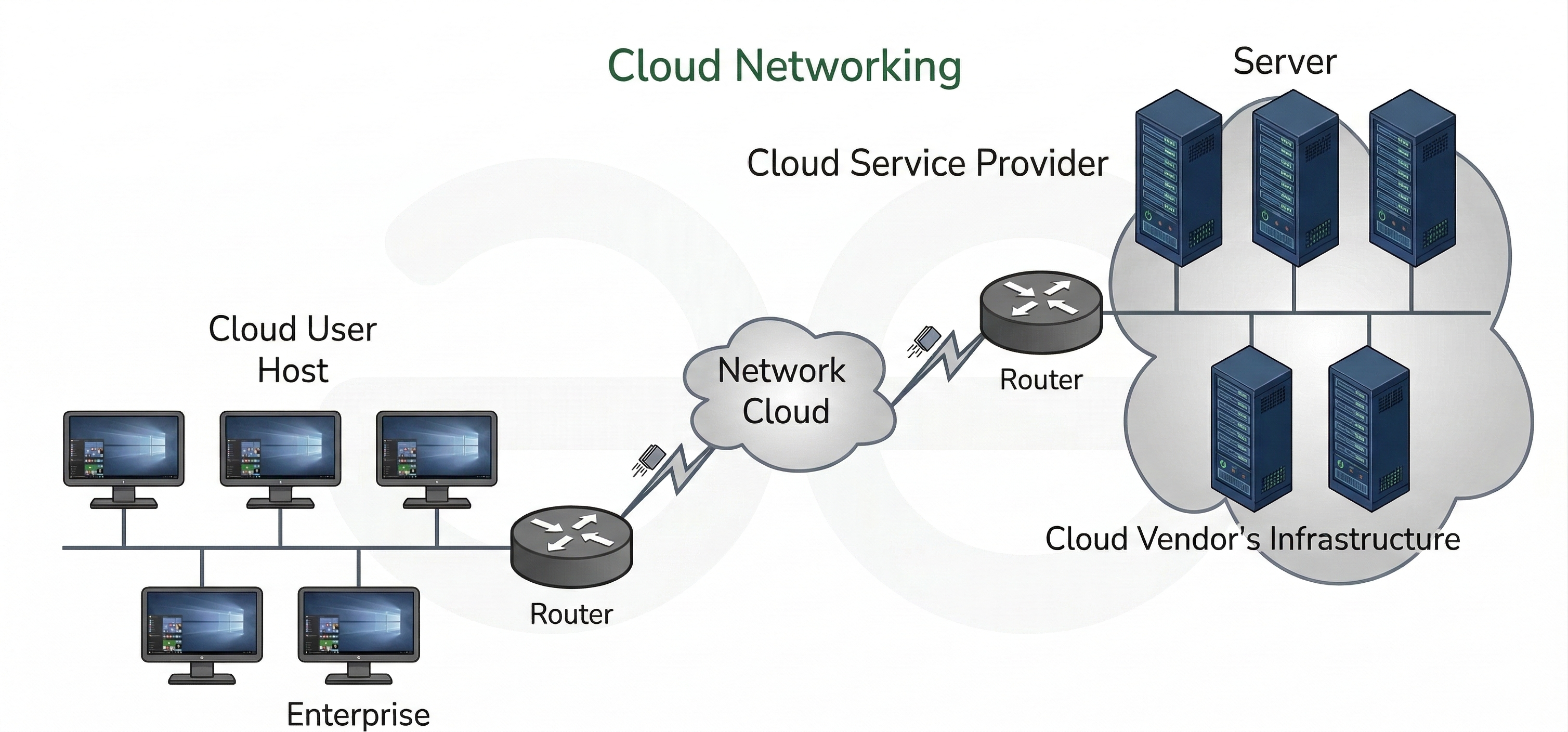
Before we move to the cloud, it is essential to understand how a basic network operates. At its core, a network is a collection of computers, servers, and devices connected to share resources.
Key Concepts:
- IP Addresses: The digital “home address” of every device on a network. (e.g., IPv4 like
192.168.1.1and the now-standard IPv6). - The OSI Model: A conceptual framework used to understand network interactions in seven layers—from Physical cables (Layer 1) to the Application you use (Layer 7).
- Protocols (TCP/IP): The set of rules that allow different devices to communicate. TCP ensures data arrives correctly, while UDP focuses on speed (used in streaming).
- Routers vs. Switches: A Switch connects devices within a single network (like your office), while a Router connects different networks together (connecting your office to the internet).
For a detailed technical breakdown of these core concepts, we highly recommend checking out GeeksforGeeks’ Computer Networking Tutorials.
2. What is Cloud Networking? (The 2026 Definition)
Cloud networking is the practice of hosting or using networking resources from a third-party cloud provider. Instead of owning physical routers and managing complex wiring, you rent virtualized networking power.
According to the AWS Cloud Networking Guide, this shift allows businesses to build global infrastructures in minutes.
Modern Deployment Models:
- Hybrid Cloud: Combining your on-premise servers with public cloud power.
- Multi-Cloud: Using multiple providers (AWS + Azure + Google Cloud) to ensure 100% uptime.
- Edge Networking: Processing data closer to the user to reduce “lag.”
3. Core Architecture: How it Functions
The architecture of cloud networking is built on Virtualization. This means your network exists as software, not just hardware. For advanced insights into network virtualization, see VMware’s Cloud Networking Topics.
Software-Defined Networking (SDN)
SDN is the “brain.” It separates the Control Plane (the logic/rules) from the Data Plane (the actual movement of data). This allows you to update network rules across the globe with a single script.
Virtual Private Cloud (VPC)
Think of a VPC as your own “Private Island” in the public cloud. It includes:
- Subnets: Dividing your network for better security (e.g., putting your database in a “private” subnet).
- Load Balancers: Distributing traffic so your website never crashes during a viral “TechUpdate24” post.
4. Top Networking Trends for 2026
Networking in 2026 is defined by Intelligence and Sub-1ms Latency.
A. AI-Driven Networking (AIOps)
Artificial Intelligence now manages networks. Self-healing networks detect a failing server and reroute traffic automatically before a human even knows there is a problem.
B. 6G and Ultra-Low Latency
With 6G rolling out, latency (delay) has dropped significantly. This is powering the next generation of real-time AI applications and the Industrial Metaverse.
C. SASE (Secure Access Service Edge)
SASE has replaced traditional VPNs. It merges networking (SD-WAN) with security (Firewall-as-a-Service) into a single cloud-native tool.
5. Security: The Zero Trust Mandate
In 2026, the old method of “trusting everyone inside the office” is dead. We now use Zero Trust Architecture (ZTA).
- Never Trust, Always Verify: Every login, every device, and every request must be verified every single time.
- Micro-segmentation: If an attacker breaches one small part of the network, they are “trapped” there and cannot access the rest of your data.
6. Comparison Table: Traditional vs. Cloud Networking
| Feature | Traditional (Legacy) | Cloud Networking (2026) |
| Speed of Setup | Weeks/Months | Minutes |
| Cost | High Upfront (CapEx) | Pay-as-you-go (OpEx) |
| Scaling | Manual & Difficult | Automatic & Infinite |
| Security | Perimeter-based | Zero Trust / Identity-based |
| Management | Physical/Manual | Software-Defined/AI-Driven |
7. Strategic Best Practices for TechUpdate24 Readers
- Prioritize IPv6: Most of the world has moved to IPv6. Don’t let your business get stuck with old IPv4 limitations.
- Automate with Terraform: Use “Infrastructure as Code” to make sure your network setup is consistent and error-free.
- Monitor Egress Costs: Cloud providers charge for data leaving their network. Always optimize your traffic routes to save money.
Conclusion
Cloud networking has evolved from a support tool into a primary business driver. By leveraging AI-driven automation and Zero Trust security, you can build a network that is not only fast but also incredibly resilient.
Frequently Asked Questions (FAQ)
Q: Is Cloud Networking safe for small businesses?
A: Yes! In fact, cloud providers often offer better security than a small business could afford on its own.
Q: Do I need to be a coder to manage cloud networks?
A: While basic coding (Python/JSON) helps with automation, most cloud providers offer very user-friendly dashboards.