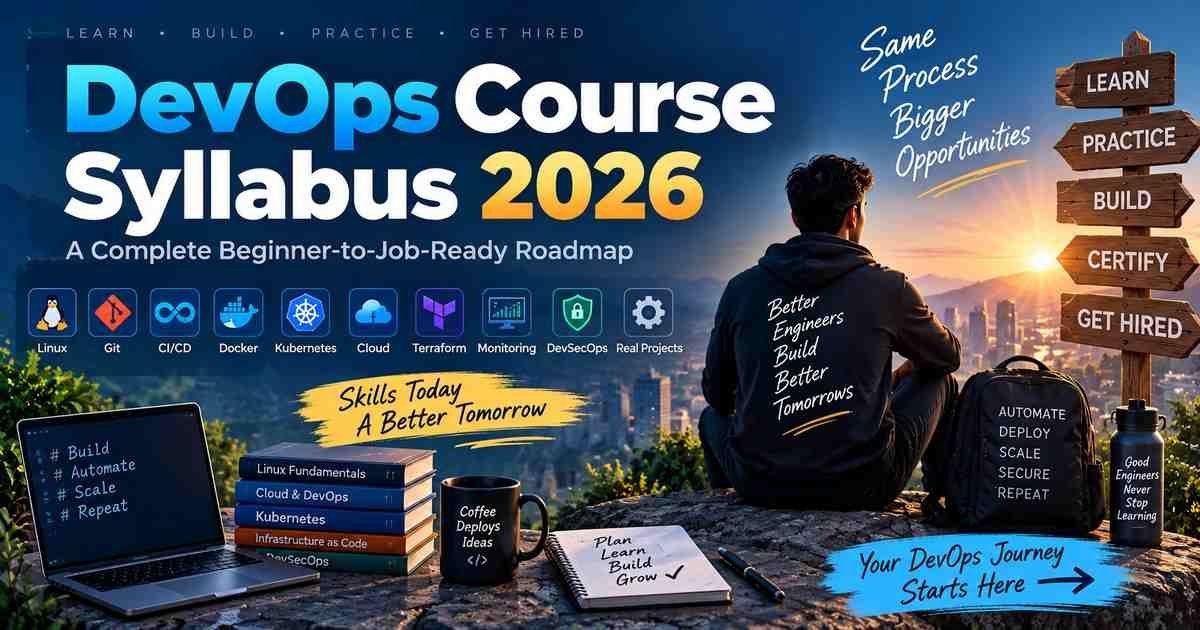
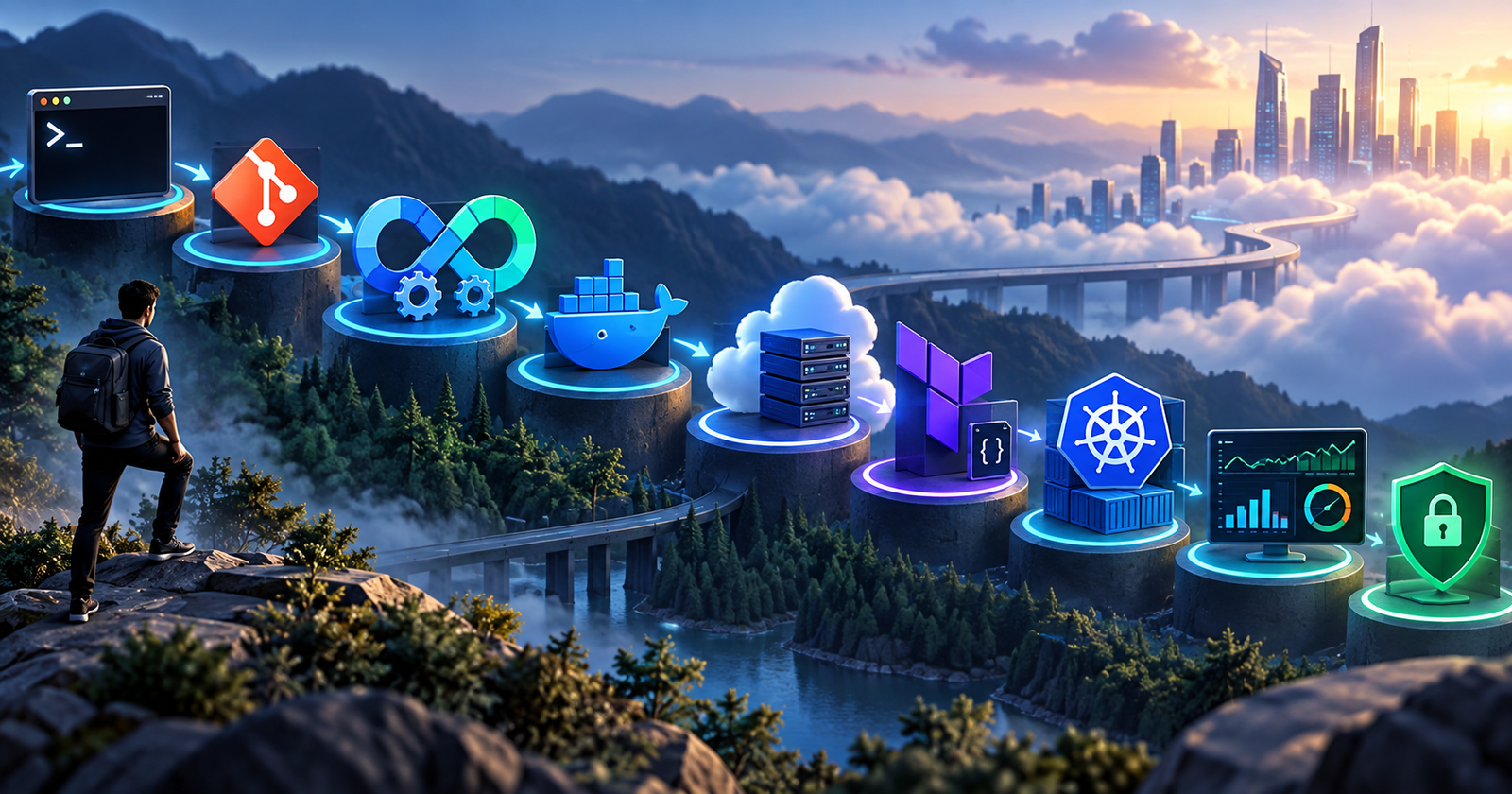
DevOps course syllabus can vary widely because DevOps is not one certification or one fixed curriculum. A good beginner-to-job-ready path should build skills in layers: Linux and networking first, then Git, CI/CD, containers, cloud, Infrastructure as Code, Kubernetes, observability, security, and real projects.
If you are starting in 2026, the goal should not be to memorize dozens of tools. The goal is to understand the software-delivery lifecycle well enough to automate repeatable work, troubleshoot failures, and operate applications safely in production.
DevOps Course Syllabus 2026: Complete Learning Path
| Module | What to Learn | Outcome |
|---|---|---|
| 1. Foundations | Linux, networking, shell, processes, permissions | Comfortable working on servers |
| 2. Git | Branches, merge/rebase, pull requests, tags | Version-control confidence |
| 3. CI/CD | Build, test, artifacts, environments, deployment | Automated delivery pipelines |
| 4. Containers | Dockerfiles, images, registries, Compose | Portable application packaging |
| 5. Cloud | Compute, networking, IAM, storage, load balancing | Cloud deployment basics |
| 6. IaC | Terraform state, modules, plan/apply, remote backends | Repeatable infrastructure |
| 7. Kubernetes | Pods, Deployments, Services, Ingress, ConfigMaps, Secrets | Container orchestration |
| 8. Observability | Metrics, logs, traces, alerting | Production troubleshooting |
| 9. DevSecOps | Secrets, SAST, SCA, image scanning, least privilege | Security inside delivery |
| 10. Projects | End-to-end cloud deployment | Portfolio and interview readiness |
Module 1: Linux and Networking Fundamentals
Start with Linux before jumping into Jenkins, Kubernetes, or Terraform. Most DevOps tooling eventually runs on Linux servers, containers, or cloud instances, so troubleshooting depends on understanding the operating system underneath.
- Files, directories, permissions, users, groups and sudo
- Processes, services, systemd and logs
- Package management
- Shell commands, pipes, redirection and basic Bash scripting
- TCP/IP, DNS, HTTP/HTTPS, ports, subnets and routing
- SSH, curl, ping, traceroute, ss/netstat and basic troubleshooting
Module 2: Git and Collaborative Development
DevOps begins with version-controlled change. Learn Git well enough to understand what a pipeline is building and why a deployment changed.
- clone, add, commit, push and pull
- branches, pull requests and code review
- merge versus rebase
- tags and release versions
- .gitignore and repository hygiene
- handling merge conflicts
Module 3: CI/CD Pipelines
Continuous integration and delivery are core DevOps capabilities. Pick one platform first—GitHub Actions, GitLab CI, Jenkins, or a cloud-native alternative—and learn the concepts deeply before switching tools.
- Pipeline triggers and stages
- Build and test automation
- Artifacts and container images
- Environment variables and secret handling
- Manual approvals and protected environments
- Rollback and deployment strategies
- Pipeline logs and failure troubleshooting
Do not hardcode cloud credentials into CI files. Long-lived keys can remain dangerous long after exposure; see our analysis of leaked AWS keys and credential risk.
Module 4: Docker and Container Fundamentals
Learn why containers exist before trying to orchestrate them. You should be able to build, run, inspect, troubleshoot, and publish an image confidently.
- Images, containers and layers
- Dockerfile instructions and build context
- Volumes and networking
- Docker Compose for multi-container development
- Container registries
- Basic image-hardening practices
Module 5: Cloud Fundamentals
You do not need to master AWS, Azure and Google Cloud simultaneously. Choose one cloud first and learn the common concepts that transfer across providers.
- Virtual machines and autoscaling
- VPC/VNet, subnets, route tables and security controls
- Load balancers and DNS
- Object storage
- IAM roles, policies and temporary credentials
- Managed databases
- Monitoring and audit logs
Module 6: Infrastructure as Code with Terraform
Terraform is valuable because infrastructure changes become reviewable and repeatable. Learn configuration, state and workflow—not only resource syntax.
- Providers, resources, variables, outputs and data sources
- Modules and reusable infrastructure
- terraform init, plan and apply
- Remote state and state locking
- Importing existing infrastructure
- Drift detection and reconciliation
State mistakes can become production problems. Our Terraform state drift guide explains how to review manual cloud changes before accepting or reverting them.
Module 7: Kubernetes
Kubernetes should come after Docker and networking. Otherwise, learners often memorize YAML without understanding what the platform is actually doing.
- Pods and Deployments
- Services and Ingress
- ConfigMaps and Secrets
- Namespaces and RBAC
- Requests, limits and health probes
- Rolling updates and rollbacks
- Persistent storage
- Helm basics
Module 8: Monitoring and Observability
A DevOps engineer should be able to answer three questions during an incident: what changed, what is failing, and what users are experiencing. That requires more than CPU dashboards.
- Infrastructure and application metrics
- Centralized logs
- Distributed traces
- Dashboards and alerts
- Service-level indicators and operational baselines
- Incident troubleshooting using telemetry
Module 9: DevSecOps
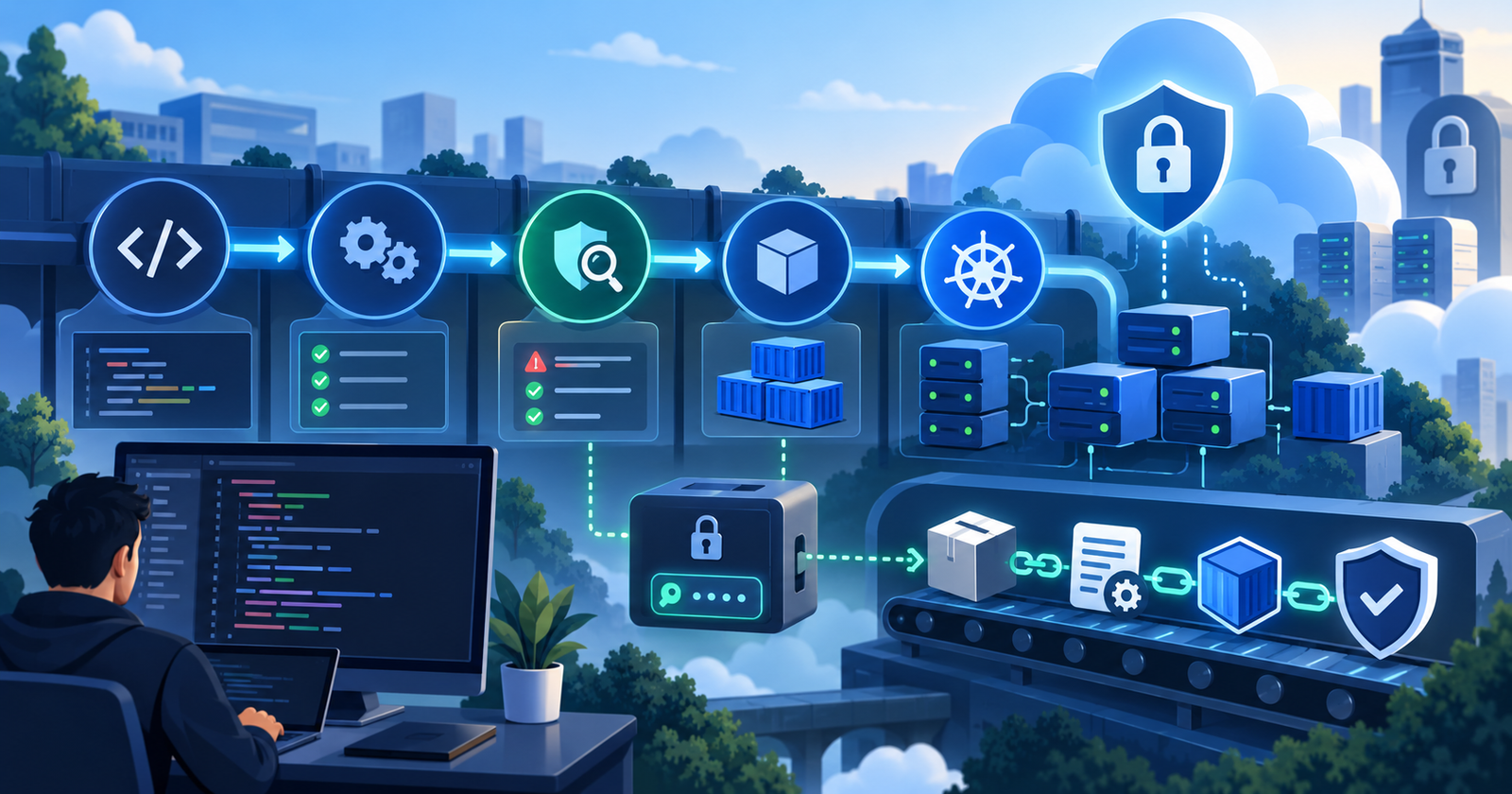
Security should be integrated into the delivery process rather than added as one final audit. NIST’s Secure Software Development Framework is designed to integrate secure-development practices into different SDLC models, while OWASP’s DevSecOps guidance focuses on embedding security activities into CI/CD.
- Secrets scanning
- Static application security testing
- Dependency and software-composition analysis
- Container-image scanning
- Infrastructure-as-Code policy checks
- Least-privilege IAM
- Software supply-chain concepts such as provenance
Module 10: DevOps Projects for Your Portfolio
A course is only useful if you can prove you can connect the pieces. Build projects that show an end-to-end delivery flow instead of ten unrelated tool demos.
- CI/CD project: build and test an application, create a Docker image, push it to a registry and deploy it automatically.
- Terraform cloud project: provision network, compute, IAM and storage with remote state.
- Kubernetes project: deploy an application with ConfigMaps, Secrets, Ingress, resource limits and monitoring.
- DevSecOps project: add dependency, secret, image and IaC scanning to a pipeline and block builds on defined policy failures.
A Realistic 6-Month DevOps Learning Plan
| Month | Focus |
|---|---|
| 1 | Linux, networking, Git and Bash |
| 2 | CI/CD, Docker and basic cloud |
| 3 | Terraform and IAM |
| 4 | Kubernetes and Helm |
| 5 | Monitoring, logging and DevSecOps |
| 6 | Projects, troubleshooting, resume and interviews |
What You Do Not Need to Learn First
Beginners often lose months trying to cover every trending tool. You do not need service meshes, advanced platform engineering, multi-cloud architecture, complex operators, or every CNCF project before applying for junior DevOps roles. Strong fundamentals plus two or three real projects are more useful than a long list of tools you cannot troubleshoot.
Bottom Line
A strong DevOps course syllabus should progress from operating-system and networking fundamentals into automation, containers, cloud, Infrastructure as Code, Kubernetes, observability and security. The tools can change; the ability to automate, diagnose and safely deliver software is the durable skill.
Official Learning References
- DORA — software delivery and DevOps research
- NIST SP 800-218 — Secure Software Development Framework
- OWASP DevSecOps Guideline
Frequently Asked Questions
Is coding required for DevOps?
You do not need to be a full-time application developer, but scripting is important. Bash, Python, YAML and the ability to read application code are useful for automation and troubleshooting.
Should I learn Docker before Kubernetes?
Yes. Understanding images, containers, networking, volumes and registries makes Kubernetes much easier to learn.
Which cloud should a DevOps beginner learn?
Choose one major cloud and learn the core concepts deeply. Compute, networking, IAM, storage, load balancing and observability transfer well between providers.
