
How do Agile and DevOps interrelate? They solve different parts of the same software-delivery problem. Agile helps teams work in small increments, respond to feedback and adapt priorities. DevOps extends that flow into building, testing, releasing, operating and improving software with shared ownership and automation.
The two are related, but they are not the same thing. Agile is broader than sprints, and DevOps is broader than CI/CD tools. A team can use Agile practices without strong DevOps capabilities, and a team can automate delivery without following Scrum. The strongest results usually come when short feedback cycles in product development are matched by short, reliable feedback cycles in software delivery.
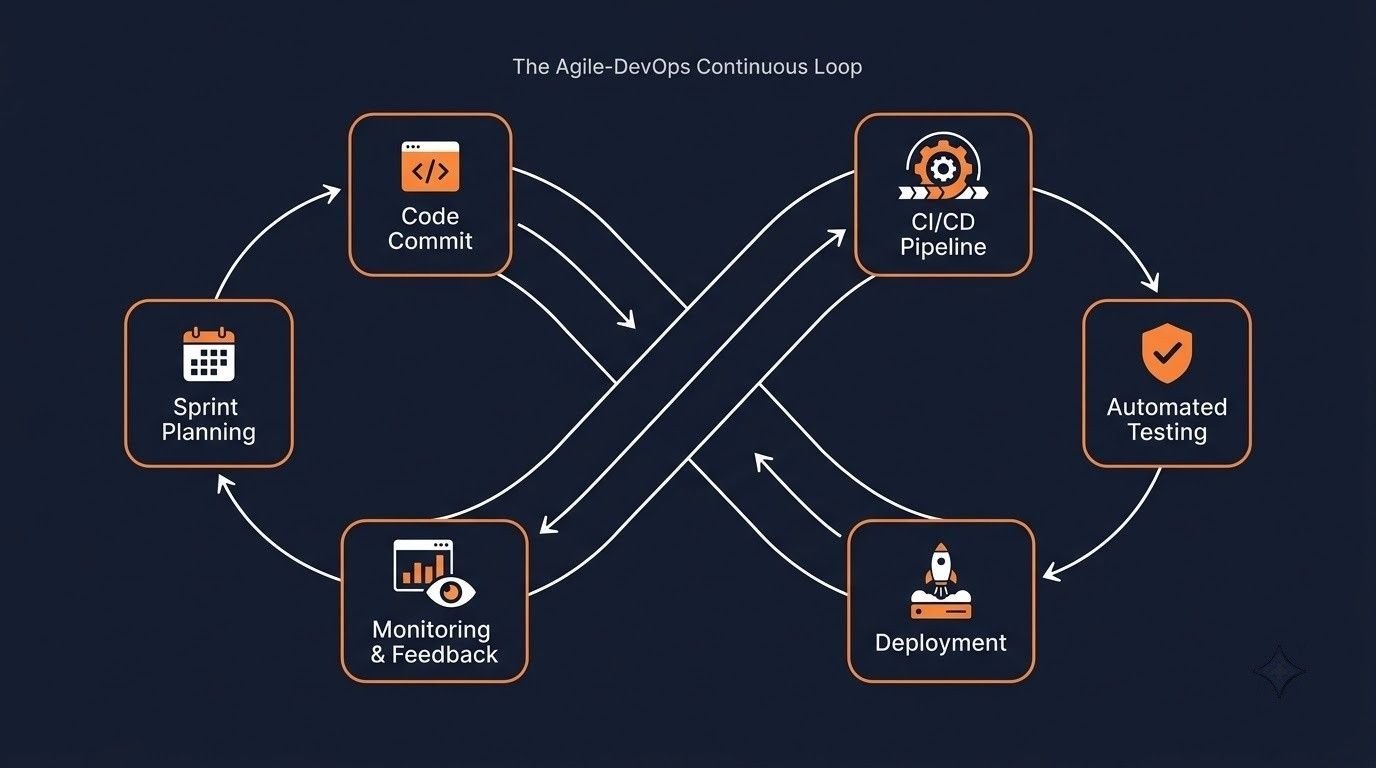
How Agile and DevOps Interrelate
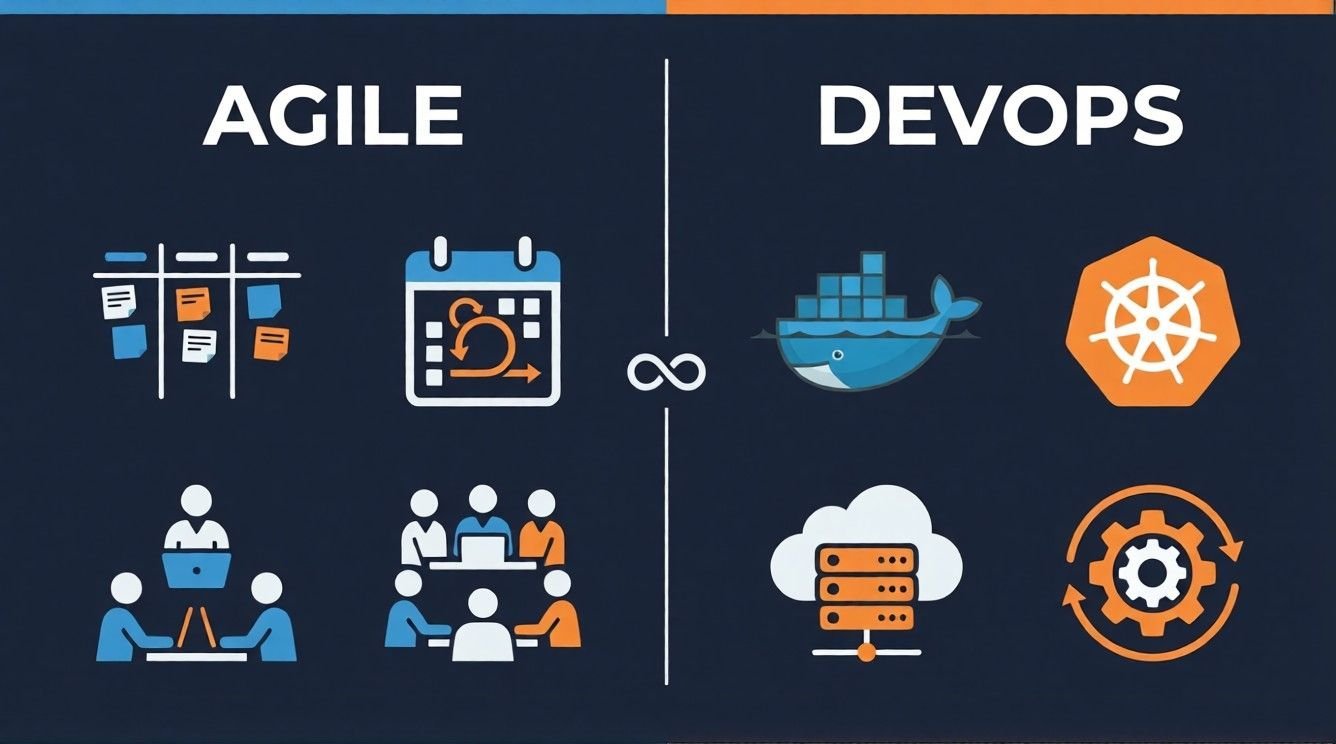
Agile focuses on delivering useful software in small increments and learning from customers and stakeholders as work progresses. The Agile Manifesto emphasizes working software, customer collaboration, responding to change and frequent delivery.
DevOps focuses on improving the flow between software development and operations by combining collaboration, automation, observability, reliable deployment practices and shared responsibility for production outcomes.
The interrelationship looks like this: Agile reduces the size of planning and development batches, while DevOps reduces the friction and risk involved in moving those changes into production and operating them. Production feedback then informs the next product decision.
Agile vs DevOps: The Difference in Simple Terms
| Area | Agile | DevOps |
|---|---|---|
| Main emphasis | Iterative product development and adapting to feedback | Fast, reliable delivery and operation of software |
| Typical feedback | Customer, product, user and team feedback | Build, test, deployment, production and reliability feedback |
| Common practices | Backlogs, iterative planning, reviews, retrospectives | CI/CD, Infrastructure as Code, observability, automation, incident learning |
| Team boundary | Often product and development focused | Encourages shared ownership across development and operations |
| Success signal | Useful software delivered and priorities adapted | Changes delivered safely, quickly and recoverably |
These are tendencies, not hard boundaries. Modern product teams often blend both sets of practices into one cross-functional workflow.
A Practical End-to-End Workflow
- Plan a small change: the team selects a user or business outcome rather than a large batch of unrelated work.
- Develop in small increments: code changes are kept reviewable and integrated frequently.
- Automate validation: CI runs tests, security checks and quality gates.
- Deploy through a repeatable pipeline: the release process is automated and versioned rather than dependent on manual runbooks.
- Observe production: logs, metrics, traces and user feedback show whether the change actually worked.
- Feed learning back into planning: incidents, performance data and customer feedback influence the next iteration.
This is where Agile and DevOps reinforce each other: both shorten feedback loops, but they collect feedback from different parts of the system.
Three Ways DevOps Strengthens Agile Delivery
1. CI/CD Makes Small Batches Easier to Ship
Agile encourages smaller, more frequent increments. CI/CD makes those increments practical by automating build, test and deployment steps. The goal is not necessarily to deploy every sprint; it is to make deployment routine enough that the team can release when the product decision says it should.
2. Infrastructure as Code Reduces Environment Friction
Infrastructure as Code helps teams create and change environments through versioned configuration. That can reduce waiting time and configuration drift between development, test and production environments.
IaC is not automatically safe, though. Manual out-of-band changes can still create drift, which is why teams need review and reconciliation workflows. See our guide to detecting and fixing Terraform state drift.
3. Operations Feedback Improves the Next Iteration
Agile teams need fast feedback, but that feedback should not stop at the acceptance test. Production incidents, latency, deployment failures, support tickets and user behavior can all reveal whether a change created value or introduced risk.
Where Security Fits: DevSecOps Without the Buzzwords
Security works best when it is part of the delivery flow rather than a final checkpoint. That can include dependency checks, static analysis, secrets scanning, container scanning and policy checks in CI/CD, combined with threat modeling and human review for higher-risk changes.
Automation does not prevent every vulnerability from reaching production. It reduces some classes of error and gives teams faster feedback. Critical vendor vulnerabilities still require patching and operational response, as shown in our coverage of GitLab CVE-2026-85706.
How to Measure Agile and DevOps Together
Teams often make the mistake of measuring Agile with only sprint metrics and DevOps with only deployment counts. That can encourage local optimization instead of better outcomes.
DORA’s current software-delivery model uses five metrics, grouped into throughput and instability:
- Change lead time — how long it takes a committed change to reach production.
- Deployment frequency — how often software is deployed or released.
- Failed deployment recovery time — how quickly the team recovers from a deployment that requires intervention.
- Change fail rate — the share of deployments that require remediation such as rollback, hotfix or fix-forward.
- Deployment rework rate — the share of deployments that were unplanned and made to address a production problem.
DORA’s current guidance also emphasizes that speed and stability are not simple trade-offs. Teams can improve both when they reduce batch size, remove bottlenecks and build reliable delivery practices.
Common Mistakes When Combining Agile and DevOps
- Calling Scrum “Agile” and Jenkins “DevOps”: both concepts are broader than a framework or tool.
- Automating a broken process: CI/CD can make a bad workflow faster without making it better.
- Keeping development and operations incentives separate: one team optimizing feature output while another is judged only on stability creates conflict.
- Ignoring production feedback: retrospectives are more useful when they include deployment and operational evidence, not only sprint activity.
- Using velocity as a performance target: story points are planning aids, not a universal productivity score.
- Over-engineering the platform: small teams do not need Kubernetes, service meshes or complex pipelines just to practice DevOps.
Can You Use DevOps Without Agile?
Yes. DevOps practices such as automated testing, deployment pipelines, Infrastructure as Code and observability can support teams that do not use Scrum or formal Agile methods. Likewise, Agile teams can exist with very limited deployment automation.
The value comes from alignment: small planning batches are most useful when delivery is not blocked for weeks, and fast delivery is most useful when the team is building the right thing and learning from users.
Bottom Line
Agile and DevOps interrelate through feedback and flow. Agile helps teams decide what to build next and learn in small increments. DevOps helps teams turn those changes into reliable software, operate it in production and feed operational learning back into the next decision.
You do not need a particular sprint length, CI tool or cloud platform to combine them successfully. The useful test is whether the organization can move a small change from idea to production safely, observe the result and act on what it learns.
Official References
- Manifesto for Agile Software Development
- Principles behind the Agile Manifesto
- DORA software delivery performance metrics
Frequently Asked Questions
Does DevOps replace Agile?
No. DevOps and Agile address overlapping but different concerns. Agile emphasizes iterative product development and adaptation, while DevOps emphasizes the flow, reliability and operation of software delivery.
Do Agile teams have to use sprints?
No. Sprints are associated with Scrum, not with Agile as a whole. Teams can follow Agile principles using other approaches, including continuous-flow methods.
Can a small startup use Agile and DevOps together?
Yes. A small team can use lightweight planning, source control, automated tests, a simple deployment pipeline and basic observability without adopting enterprise-scale tooling.
